
The Full History, Assembled.
The typical patient has records from 10 locations and 20+ providers. Few of them talk to each other. Automated Patient History solves the problem underneath every other clinical data problem: getting the full record in the first place.
The platform retrieves patient records from across the country, consolidates them into a single longitudinal history, and hands the result to whatever workflow needs it next.
How it works
Three data intake rails.
Each available depending on your use case.
From any source to any system.
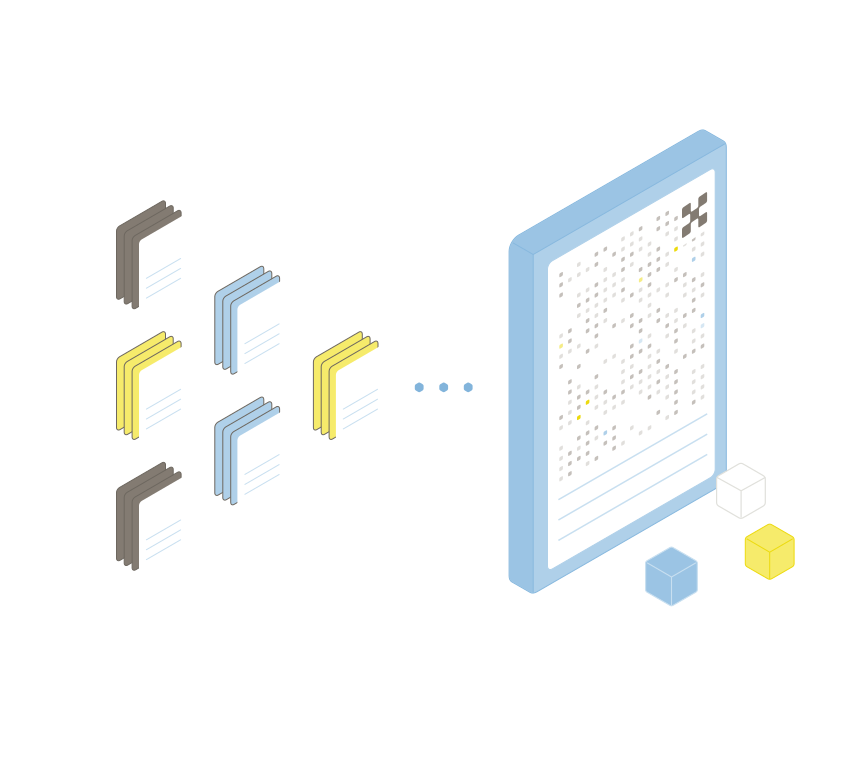
Records can arrive in any source format: FHIR, CCDA, PDFs, images. The engine cleans, deduplicates, and standardizes the data into a clean structured data model, and contextualizes the documents with embeddings, labeling, and metadata to continuously improve the assembled history.
The output is delivered into the receiving system: timeline views with interactive filters, clinician dashboards, custom views, or API endpoints.
Our capabilities
What we deliver
Target users
Who it is for
BY THE NUMBERS
Clarifying metrics
200,000+
Queries possible in 24 hours
10M+
Document downloads possible in 24 hours
5-15 Min.
For high-yield data structuring
60 Min.
For 10-year deep history with all available document classes
Results based on a retrospective analysis of a defined historical dataset and do not guarantee future performance
EVIDENCE
What people say.
Without automation, reviewing patient history can take hours per case, or not happen thoroughly at all. xCures helps clinicians get the information they need quickly so they can focus on care instead of chart review.
VP of Product Management, Digital Health Organization
See what a complete patient history looks like.
A 30-minute demo with our team. No prep required. We will use synthetic patient records and show you exactly how it works.
Frequently asked.
How does xCures get the data?
xCures® retrieves medical records through three pathways:
- Treatment-based retrieval used by healthcare providers pursuant to their treatment relationships
- Individual Access Services (IAS) for organizations building digital front doors to power patient advocacy, research, trials, and care support
- API-facilitated direct upload for organizations bringing their own data
Together these pathways give xCures coverage across treatment, consumer, and direct-upload sources.
How does xCures handle duplicate records across care sites?
xCures cleans, deduplicates, and standardizes records before they reach the user. The engine reconciles duplicate entries across care sites and source formats. Replicated structured data is collapsed to a single entry with source document links. The result is one structured longitudinal timeline, not a stack of raw documents. Deduplication runs automatically during assembly, not as a manual downstream task.
What is IAS?
IAS stands for Individual Access Services. It is an individual-authorized record retrieval pathway. Individuals request their own records through the IAS-enabled platform pursuant to your relationship with such individual(s). IAS is available as a fully white-labeled suite.
What format is the assembled patient history delivered in?
xCures delivers the assembled patient history in FHIR R4, the interoperability standard used across modern healthcare systems. Native source documents stay accessible alongside the structured output. The engine supports timeline views, clinician dashboards, and custom views.
Which healthcare teams use Automated Patient History?
xCures Automated Patient History is used by diagnostic labs that need prior history to interpret a result, telehealth providers who need a patient’s clinical context before a visit, provider organizations consolidating patient data across acquisitions and affiliated networks, and digital health platforms and apps that need clinical depth on every patient.